Crossing the Chasm from QSR to QMSR
Jun 23, 2026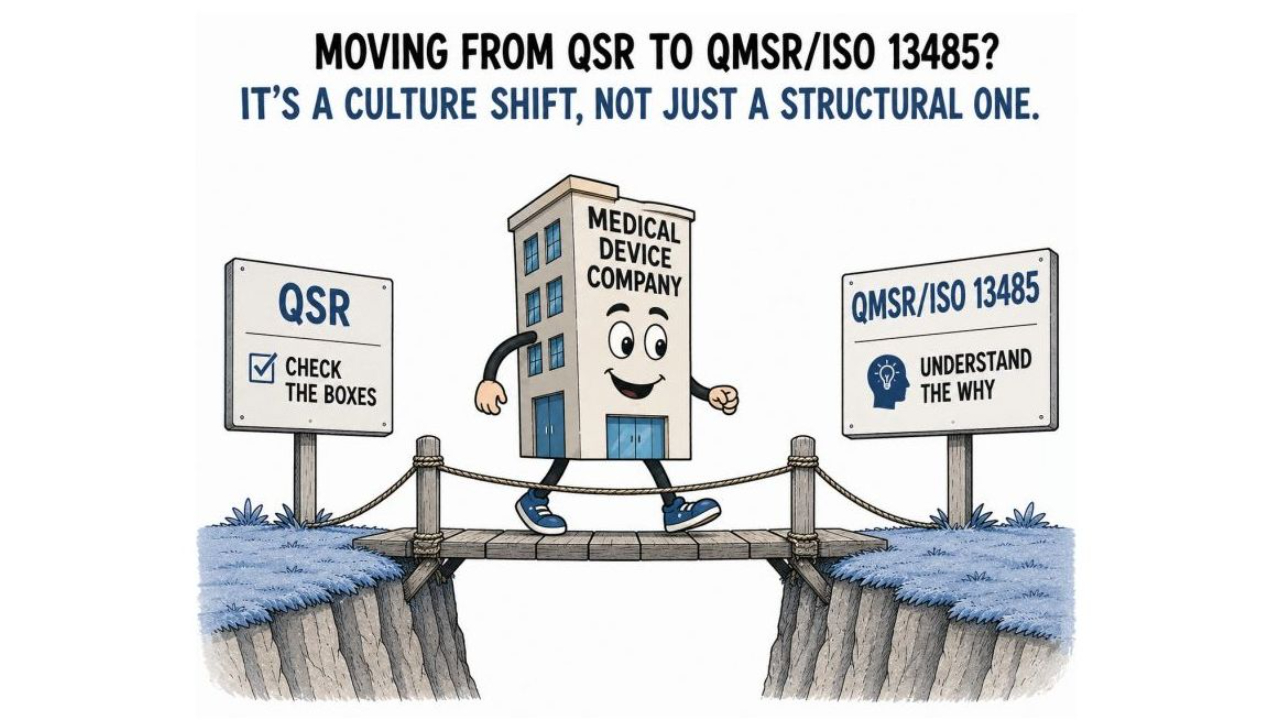
Are you adapting an existing quality system from QSR to QMSR/ISO 13485?
If so, you're not alone, and you may be finding that the transition isn’t completely seamless.
To bring everyone up to speed, on February 2, 2026, the FDA formally replaced the Quality System Regulation (QSR) with the Quality Management System Regulation (QMSR), harmonizing U.S. requirements with ISO 13485:2016. While it may sound like an administrative update (we did only add one "M" to the acronym, after all) there are significant substantive changes between the two paradigms that medical device companies need to consider as they make the change.
Perhaps the most important change is a realization on the part of medical device companies that the shift isn't just structural but cultural. The old QSR was very checkbox-oriented (e.g. - maintain a Design History File, establish a CAPA process, control your documents). The new QMSR is far more concerned with the why behind these processes. It asks you to demonstrate that risk thinking is embedded in how decisions get made, and that continual improvement isn't just a section in your quality manual but is something that actually happens.
In practical terms, it means your team can answer questions like:
- Why is this step in the procedure? (Not just "because the SOP says so," but the actual risk or regulatory rationale.)
- What would happen if this control failed, and how would we know?
- How does this process connect to the safety and performance of the device?
In short, your people, not your documents, become your quality system.
The good news is that if your quality culture is strong, the transition is manageable. If it isn't, this is the right moment to address it.
As you manage this transition, we at Archimedic are happy to provide our perspective. Reach out and let’s think it through together.
Support for MedTech at Every Stage
Archimedic partners with medical device teams to solve complex design, development, regulatory, and go-to-market challenges.