The Other AI You Should Be Thinking About
Aug 05, 2026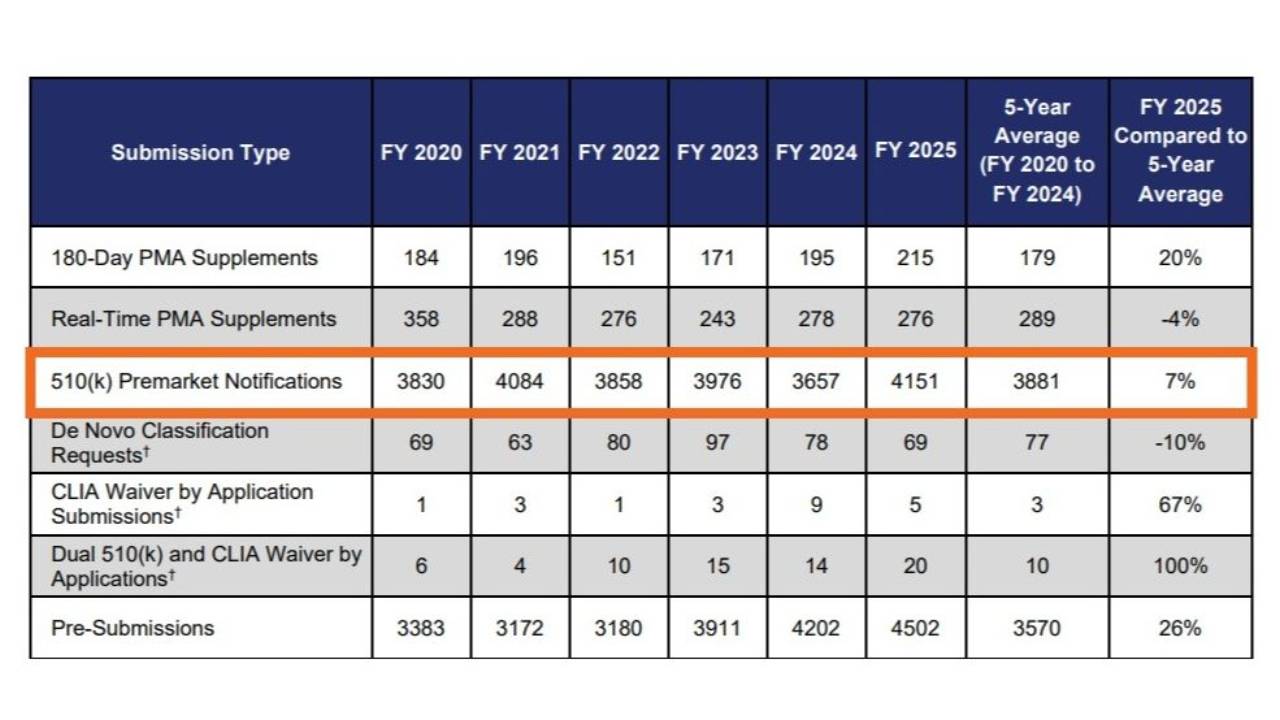
If you're building medical devices, there's an "AI" that will determine your time to market far more than the one in every headline right now. It's the Additional Information request, and understanding how it works is key to a realistic 510(k) plan rather than an overly optimistic one.
You've probably seen a scary fact thrown around, something like "most 510(k) submissions get rejected." It's rooted in reality but often misunderstood. That misunderstanding can cause founders and managers to focus on the wrong things. A 510(k) isn't a single pass-fail event. It's a stage-gate review where a pass or fail at each stage has its own likelihood and effect on your calendar. Here's a look at the process using the FDA's own FY2025 performance data.
Volume of Submissions
In FY2025, the 510(k) program took in a review workload of about 4,151 submissions, up 7% from the five-year average of roughly 3,881.¹ It remains by far the most common path to the US market. So, whatever happens inside this process happens to thousands of companies a year, and because of that volume, we have some statistically significant information we can use to plan.
Gate 1: The Acceptance Check
Before the FDA reviews the substance of your submission, it runs an administrative check to confirm the submission is complete enough to review. Under the FDA's Refuse to Accept policy, this early review happens within the first 15 calendar days, and it tells you whether your submission is administratively complete or, if not, which elements are missing.² It's not about whether your device is good. It's about whether everything required is present: device description, indications for use, labeling, performance testing, biocompatibility, cybersecurity, and the rest of the checklist.²
Historically, a large share of submissions got rejected right here because of preventable administrative gaps rather than anything scientific. This likely is also a source of that scary statement that most 510(k)s get rejected. To alleviate the problem, the FDA moved to the eSTAR electronic template, which became mandatory for 510(k)s on October 1, 2023.¹ The template forces completeness of submissions by walking you through every required element, and the FDA names this modernization directly as one of its corrective actions for review timelines.¹ For eSTAR submissions, the FDA now uses a technical screening for completeness rather than the traditional RTA process, but the principle is still the same: if the package isn't complete, they will not spend more review time on it and it doesn't move forward until you fix it. That generally avoidable fix can cost you calendar time (money) you didn't budget for.
Gate 2: The Additional Information Request
Once accepted, your submission enters substantive review, where a reviewer evaluates whether your device is "Substantially Equivalent" to its predicate. Remember, on the 510(k) pathway, that is the bar. In case you would like a refresher: a device is Substantially Equivalent if it has the same intended use as a legally marketed predicate device and either the same technological characteristics, or different characteristics that don't raise new questions of safety and effectiveness and are backed by data showing it's at least as safe and effective as the predicate.
Around day 60, the reviewer either moves toward a decision or issues an Additional Information request. In FY2025, of the completed 510(k) substantive interactions, the FDA issued an Additional Information or Major Deficiency letter in 1,976 of 2,989 cases. That's about 66%.¹ Two out of three submissions get one.
This is another statistic that gets misquoted as a "rejection." It is not a rejection. It's the FDA pausing the review clock and asking for clarification or more evidence before deciding. And that pause can cause a lot of reshuffling when it comes to your timeline.
Why the 90-Day Clock Can Become Many Months
The FDA's headline 510(k) goal is 90 FDA days. But "FDA days" only counts time while the submission is actively with the agency. When an AI request is issued, the clock stops and does not restart until you respond. You get up to 180 calendar days to do so.
This is why actual total time to decision runs far longer than 90 days. The FDA's own most recent closed cohort data shows a 510(k) total time to decision of 139 days, with comparable prior years of 147 days in FY2022 and 141 days in FY2021.¹ And the FDA is explicit about why. In its own words, the 510(k) total-time goal combines FDA review time and the time industry needs to respond to deficiencies while the clock is on hold, and submissions placed on hold increased the total review time even though the FDA met its active-review goals.¹
Despite what many may think, the delay isn't primarily the FDA being slow. It's the back-and-forth. Every AI request you trigger is time the 90-day clock isn't counting. Your schedule keeps pushing out while you scramble to run a test you didn't plan for or rewrite a section that wasn't clear. The agency sees it as still hitting its own review targets, but founders, managers, and investors were counting on 90 days. Statistically, it's more likely to be 4+ months because of the hold time.
Gate 3: The Decision
At the end of review, the FDA issues its determination: Substantially Equivalent, meaning cleared to market, or Not Substantially Equivalent.
The good news if you make it to this point is a genuine Not Substantially Equivalent decision is comparatively rare. In FY2025, among completed 510(k) decisions, NSE determinations and equivalent denials numbered 45 out of 1,914 completed decisions.¹ The large majority of submissions that reach a decision are cleared. The pain in the process is overwhelmingly about time, rework, and running over budget at Gate 2, not final rejection at Gate 3.
So, it's a bit more nuanced than "most submissions are rejected." It's more like most submissions asked for more information mid-review, the clock stopped while you responded, and the calendar, not the FDA, was your real adversary. Most devices that start the process do eventually clear. They just take longer and cost more than their sponsors planned.
What Actually Shortens the Path
All signs point to the same conclusion. The expensive part of a 510(k) isn't the review. It's the rework the review triggers, and the clock-pause time that rework costs you. The AI request that lands on day 60 is almost always tied to a decision you made months earlier: a predicate that doesn't quite fit, an indications for use statement that's too broad, or a test that doesn't demonstrate what the reviewer needs to see.
The single best hedge happens before any of this: the Pre-Submission. A Pre-Sub is a formal meeting where you get the FDA's written feedback on your predicate, your indications for use, and your test plan before you spend the money running tests and writing the submission. It's the cheapest de-risking dollars spent in the process, because it lets you resolve issues at the conversation stage before they become an Additional Information request months and many dollars later.
The teams that clear fastest aren't the ones with the most impressive technology. They're the ones who treated the submission as an argument to be built deliberately, aligned with the FDA early, and walked into each stage having already anticipated what it was checking for.
If you're planning a 510(k) and want a second set of eyes on your predicate strategy or test plan before you commit, contact us to set up a call.
Rightley McConnell
VP Client Engagement
Sources
- U.S. Food and Drug Administration, "Medical Device User Fee Amendments (MDUFA) FY 2025 Performance Report to Congress." https://www.fda.gov/media/191127/download. Figures for 510(k) review workload, Additional Information and Major Deficiency letter counts, NSE decision counts, total time to decision, and the FDA's explanation of clock-hold time are drawn from this report (see Table 6, Table C-2, and the FY2024 and FY2025 corrective action sections).
- U.S. Food and Drug Administration, "Refuse to Accept Policy for 510(k)s," guidance for industry and FDA staff, April 21, 2022, and the FDA "Acceptance Checklists for 510(k)s" page. https://www.fda.gov/medical-devices/premarket-notification-510k/acceptance-checklists-510ks.
Support for MedTech at Every Stage
Archimedic partners with medical device teams to solve complex design, development, regulatory, and go-to-market challenges.