The Design Decision That Can Make Your Device Unpayable
Jul 23, 2026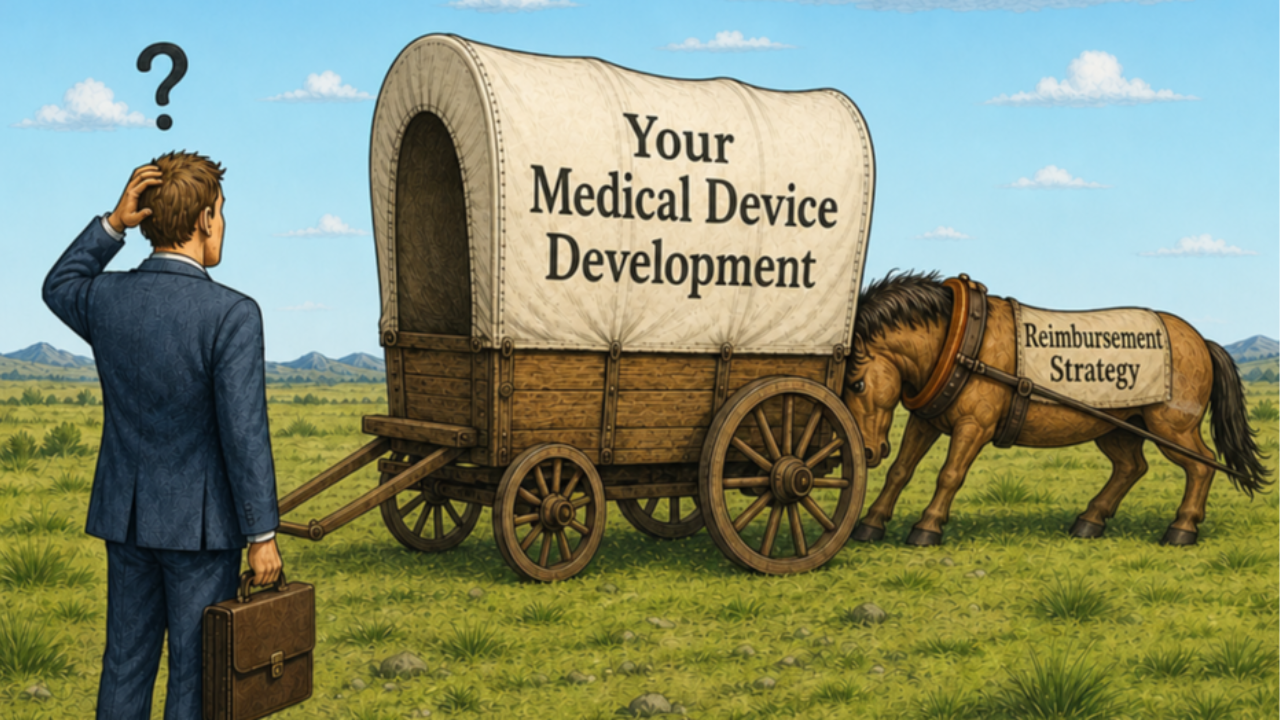
Most founders treat reimbursement like taxes: something to deal with once the real work is done. Build the device, get it cleared, then figure out how to get paid. That sequence is backwards, and it's one of the most expensive mistakes early-stage companies make.
The code you intend to bill under determines the claims you have to support. The claims determine the clinical evidence you need. And the evidence shapes the device you build. By the time most founders discover this, the design is frozen, the money is spent, and the reimbursement pathway they assumed would be there either doesn't exist or doesn't pay what the business model requires.
Working backward from the payment
When we work with founders on go-to-market, we work backward from the payment before we look forward from the technology. The logic runs in four steps.
First, identify the realistic reimbursement pathway. Is there an existing code that fits, or will the device require a new one? Existing codes are faster to revenue but constrain what you can build. New codes offer differentiation but add years and risk.
Second, understand what that code actually requires. Coverage is not the same as a code existing. Payers attach medical necessity criteria, documentation requirements, and evidence expectations to every code. Some require a prescription. Some require a face-to-face encounter. Some require proof the patient tried and failed a cheaper option first.
Third, translate those requirements into claims. If you want to bill under a code that covers a specific therapeutic use, your device has to be able to make that therapeutic claim, which means your clinical and regulatory strategy has to support it.
Fourth, translate the claims into design. Only now, with the payment logic understood, do you know what the device actually has to do, for whom, and in what setting.
A concrete example
Consider a company building an electrical stimulation device for pain management and muscle rehabilitation. The core technology is well understood and legitimately reimbursed. It seems like a straightforward path to revenue.
But the reimbursement landscape is fragmented in ways that directly implicate design.
A transcutaneous electrical nerve stimulation device bills under one family of codes, and the number of leads it uses actually changes the code. A two-lead device and a four-lead device fall under different identifiers with different reimbursement. That is a design decision, made early, with a direct payment consequence.
A neuromuscular stimulation device is a different code entirely, with different coverage criteria and different evidence expectations.
Here is where founders get into trouble. The instinct is to build the most capable device possible, so the temptation is to combine modalities: TENS, plus neuromuscular stimulation, plus interferential current, all in one unit. More capability, more appeal, right?
Except several major payers explicitly classify multi-modality combination devices as investigational and do not cover them at all.
Seemingly paradoxically, a design choice made to add clinical value can eliminate reimbursement entirely. The engineering instinct and the reimbursement reality point in opposite directions, and the founder who doesn't know that until the device is built has a very expensive problem.
Setting cascades just as hard
The same underlying technology changes character completely depending on where it's used.
If the device is intended for the patient to use at home, insurance treats it like a piece of home medical equipment, the same category as a wheelchair or a home oxygen machine. That category comes with its own rulebook before insurance will pay for it. A doctor has to prescribe it. The order usually has to be written down and signed a specific way. And for certain devices, the patient has to actually see a doctor in person first, a real appointment, not just a phone call, before the device can be shipped to their house. On top of that, the device has to be safe and usable by an untrained patient, which drives a heavy human factors and labeling burden.
If instead the device is administered in a clinic by a trained professional, the reimbursement mechanics, the durability requirements, the cleaning and multi-patient-use requirements, and the user interface all change completely.
Same core technology. At least three viable products. Three different reimbursement realities. Three different design specifications. And the decision that separates them is one most founders defer until long after the prototype works.
Why this matters for fundraising
Investors who know medtech ask about reimbursement early, and they ask about it specifically. A founder who can articulate the target code, the coverage criteria, the evidence plan to satisfy them, and how those requirements shaped the device is a founder who has de-risked the single most common reason good devices fail to become good businesses. A founder who says "we'll figure out reimbursement after clearance" is signaling the opposite.
I've sat through many pitch competitions. The device that gets funded is often not the most technically impressive one in the room. It is the one whose design, regulatory, and go-to-market strategy all point in the same direction.
Reimbursement is the discipline that forces that alignment, and the earlier it enters the conversation, the cheaper it is to get right. If you're building something and you haven't worked backward from the payment yet, that's the conversation worth having before your next design review.
If you're working through the interplay of reimbursement and design, contact us to set up a call.
Support for MedTech at Every Stage
Archimedic partners with medical device teams to solve complex design, development, regulatory, and go-to-market challenges.